
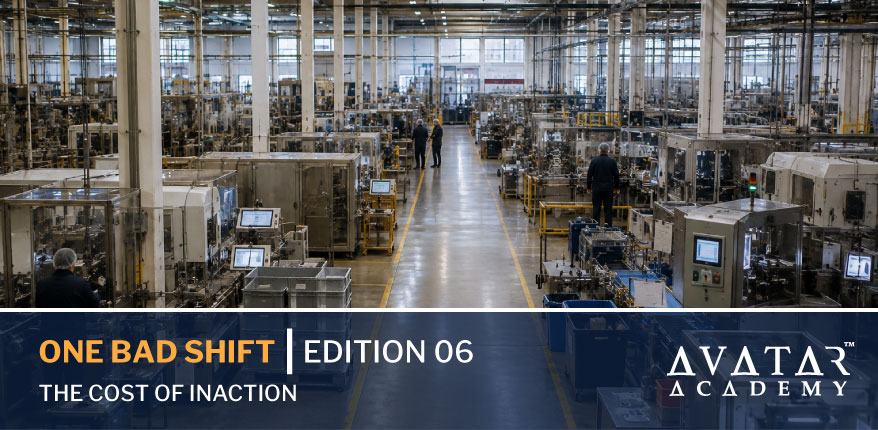
The cost of inaction is the one cost most manufacturing and life sciences leaders never calculate, because it never arrives as a single number on a single invoice. It arrives quietly, spread across every shift, every departure, every audit, and every growth phase, disguised as the ordinary price of doing business. This is Edition 06, the final edition of One Bad Shift, a series that has spent five editions putting a number on the cost of an undertrained workforce. This edition adds it all up, and asks the only question that actually matters: what is staying the same costing you?
Five Editions. One Underlying Cost.
Across this series we have looked at five distinct ways an undertrained workforce costs an operation money.
We started with the cost of undertrained operators: one missed step, one compromised batch, and a cost that reaches far beyond the scrapped material once investigation time, CAPA, and regulatory exposure are counted. We looked at the cost of operator turnover, which runs to three to five times the recruitment invoice once the productivity gap, the SME burden, and the quality risk are included. We examined the cost of knowledge loss: the tacit knowledge that leaves with every experienced employee and the slow erosion of institutional memory that follows. We walked through the cost of an audit failure, where training documentation gaps become findings, CAPAs, and regulatory escalation. And we looked at the cost of scaling on a training model built for a smaller operation.
Five different scenarios. One underlying cause. In every case, the cost was not created by bad people or bad intentions. It was created by a training model that was never built to prevent the problem it was eventually blamed for.
Why the Cost of Inaction Is Invisible
Every cost in this series shares a common feature: it never appears as a line item that says “training model.” It appears as scrap, as CAPA hours, as SME overtime, as a compliance finding, as a delayed scale-up. Each cost gets attributed to its own cause, investigated on its own terms, and absorbed into its own budget.
This is precisely why the cost of inaction is so easy to underestimate. No budget line says “cost of not changing our training model this year.” That cost is distributed across a dozen different lines, each individually explainable, each individually tolerable, none of them prompting the question that connects them.
$1.5 trillion lost annually by the world’s largest manufacturers to unplanned downtime, roughly 11% of their revenues.
The money is real. It is simply never gathered in one place where a decision-maker has to look at it.
A COO who reviews scrap rates, audit findings, onboarding timelines, and turnover costs as separate items will rarely see the pattern. A COO who reviews them as five symptoms of the same underlying condition sees something different: a training model quietly taxing every part of the operation, every day.
That is the status quo tax. Not a single cost, but a recurring one, paid whether or not anyone notices it being paid.

Calculating Your Own Status Quo Tax
Here is the exercise this series has been building toward. Estimate, for your own operation:
- The cost of your last training-related production failure, including investigation, CAPA, and regulatory exposure
- The fully loaded cost of your last three operator departures, including the productivity gap and SME burden
- Your best estimate of the institutional knowledge lost through recent retirements or resignations
- The cost of your most recent audit finding related to training documentation, if you have had one
- What your last scale-up cost in quality variance, compliance drift, or delayed timelines
Add them together. For most operations, the combined figure is substantially larger than any individual department has calculated, because no single department owns all five categories. Quality owns the audit findings. HR owns the turnover cost. Operations owns the scrap. Nobody owns the total.
That total is your status quo tax. It is not hypothetical. It is the sum of costs you have almost certainly already paid this year, and will pay again next year if nothing changes.
The Asymmetry Most Operations Get Wrong
The natural instinct when considering a change to a training model is to weigh the cost of change against the cost of staying the same, as though the second number were zero. This series has shown it is not zero. Properly counted, the cost of inaction is often the largest number in the comparison.
Expected a one-year payback on VR training and reached it in a couple of months, alongside a 75% cut in training lead time and a 50% cut in scrap.
16,000 + healthcare operator training sessions within 10 months with a virtualised Line Clearance course.
In both cases the deciding factor was the same: once the cost of inaction was calculated honestly, it stopped being tolerable.
The asymmetry runs the opposite way from how most operations instinctively weigh it. Change has a visible, upfront cost: a development engagement, a licensing decision, a transition period. Inaction has an invisible, recurring cost, paid every shift, every departure, every audit cycle. One cost is easy to see and hard to pay. The other is easy to pay and hard to see. That is exactly why it persists.
The answer running through this series is the one we set out in full in Edition 05: training built as infrastructure rather than activity. Available on demand, consistent by design, documented automatically. It does not eliminate the pressures of running an operation. It determines whether your training model absorbs those pressures or amplifies them.
The Question This Series Has Been Building Toward
Every edition of One Bad Shift has ended with a version of the same question, applied to a different scenario. This final edition asks it plainly.
What is your training model costing you, not on its worst day, but on every ordinary day you have not been counting?
Six editions, one argument: the cost of an undertrained workforce is real, it is larger than most operations calculate, and it is distributed in ways that make it easy to ignore. The organisations that answer the question honestly tend to discover the same thing. The status quo tax has been larger than the cost of change for longer than they realised. The only decision left is whether to keep paying it.
If any part of this series described your operation, that is a conversation worth having, and we would be glad to have it with you.