
The problem is not a lack of people. It’s a lack of prepared people.
Walk onto any manufacturing floor today, and you’ll hear the same complaint: “We can’t find qualified operators.” The skills gap in modern industry is widening. And the traditional solution, throwing new hires onto expensive production machinery and hoping they learn before something breaks, isn’t just inefficient. It’s expensive, risky, and increasingly untenable.
But what if you could take someone with zero technical background and transform them into a competent, confident machine operator, without wasting a single gram of raw material, without risking a single piece of expensive equipment, and without slowing down production even for a minute?
That’s exactly what Avatar Academy’s VR training platform delivers.
The Cost of Doing Nothing
Every day a new hire spends shadowing an experienced operator is a day they’re not contributing at full capacity. Every mistake made on live equipment costs money in scrap, rework, and potential damage. Every safety incident on the training floor carries a cost that goes far beyond the immediate repair bill.
Immersive training can reduce training times for task workers by as much as 75%. Companies like Mars Wrigley have cut training from 12 weeks to just 4-6 weeks using VR, driving a $19 million business impact in the process.
Three Barriers VR Removes
1. The Physical Barrier
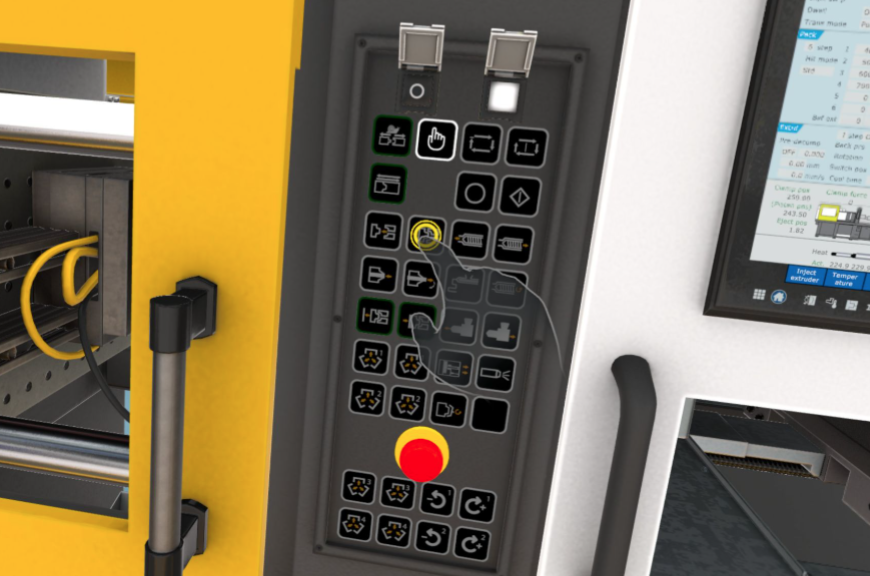
Traditional industrial training requires access to the actual machine. That means raw materials, energy consumption, and wear-and-tear on multi-million-euro equipment. Avatar Academy trainees execute hundreds of injection moulding cycles, machine purges, and robotic arm operations—without wasting a single gram of plastic or causing a penny of equipment damage.
2. The Safety Barrier
The fear of making a mistake on live equipment is real—and it’s a barrier to learning. When trainees know that a wrong move could mean injury or thousands of euros in damage, they hesitate. They don’t experiment. They don’t build muscle memory.
In VR, trainees can experience worst-case scenarios—high-pressure leaks, robotic collisions, structural fires—with absolutely zero risk of physical injury. They build confidence through repetition, not through surviving close calls.
3. The Data Barrier
Traditional training is a black box. You send someone to shadow an operator, and you hope they’re learning. With Avatar Academy, every session generates data: completion rates, procedural efficiency, error occurrences. Administrators can see, in real time, exactly which modules each trainee has mastered and where they need more work.
The Result: A New Kind of Talent Pipeline
Avatar Academy doesn’t just train individuals. It builds a direct, friction-free talent pipeline for modern industry. Trainees emerge not only with technical knowledge but with demonstrated, data-backed competency—verified by the platform and accessible through the Avatar Academy Web Portal.
For employers, that means drastically reduced onboarding time and recruitment risk. For workforce development providers, it means a curriculum that transforms raw recruits into production-ready operators. And for trainees, it means a genuine pathway into high-demand, well-paying industrial careers.
The Bottom Line
The skills gap isn’t going to close itself. But with VR training, we finally have a tool that can close it—faster, safer, and more cost-effectively than any method that came before.
The question isn’t whether to adopt VR training. The question is how soon you can start.
Avatar Academy is the flagship VR training platform from Mersus Technologies, delivering realistic, interactive industrial simulations that build workforce competency safely, consistently, and at scale. Learn more at avataracademy.io.