
The Challenge: Physical and Financial Barriers to Technical Training
FIT faced critical constraints in delivering hands-on VR Simulator robotic arm and PLC training: the prohibitive size and €30k+ cost of physical robots severely limited student access, while fixed lab schedules and geographical requirements created training bottlenecks.
Traditional methods forced students to share scarce equipment, extending certification timelines and preventing scalable, remote skill development. Without immersive VR Simulator practice, trainees couldn’t safely build muscle memory or repeat complex procedures—jeopardizing competency and operational readiness.

The Solution: Immersive VR Simulator with Real-World Fidelity
FIT partnered with Mersus Technologies to develop a comprehensive VR Simulator training suite on the Avatar Academy Platform, featuring true-to-life replicas of industrial robotic arms and PLC systems. Using hand-tracking technology (via Meta Quest headsets), trainees interact with virtual machinery through hands-free VR interaction—eliminating controllers and mirroring real-world operations. The digital twin VR simulations were engineered to match physical equipment 1:1, delivering industrial VR upskilling by replicating every button press, movement trajectory, and teach-pendant function with precision. As one trainee, Daire Sherwin emphasized: “Everything moved the same… it took almost the same presses to do an identical movement in VR Simulator as in real life”. This authenticity empowered safety-critical VR simulations, allowing users to experiment risk-free, building muscle memory without fearing costly errors.
When I went back, I’d already absorbed so much, unbeknownst to myself, so that when I tried the training content a second time, I was pacing through it much faster.Peter Davitt, CEO, FIT
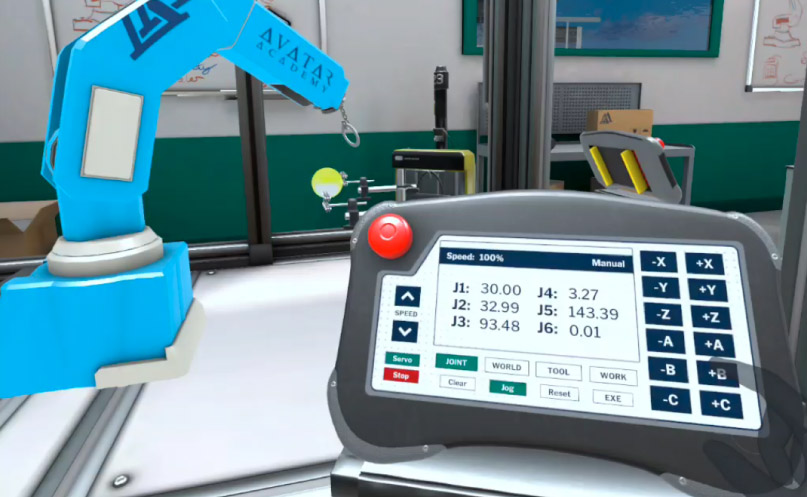
✅ Zero Equipment Downtime VR simulations enabled 24/7 training without disrupting live production or requiring physical lab access
✅ Unlimited Practical Repetitions Trainees could repeat complex procedures (e.g., robotic arm operations) without material waste or safety risks
✅ Zero material waste, sustainable training solution
Breaking Physical and Geographical Barriers
The solution directly addressed FIT’s core constraints:
VR enabled 8–10 trainees to practice simultaneously on virtual robots versus 1–2 on physical equipment, accelerating onboarding.
Remote, asynchronous training eliminated travel needs and rigid schedules. Trainees could repeat complex tasks (e.g., washer placement sequences) indefinitely, cementing procedural fluency.
Headsets replaced bulky robots for school demonstrations, sparking interest in manufacturing careers. As CEO Peter Davitt noted: “Walking into schools with a VR headset gives students a realistic impression of advanced manufacturing”
Future-Proof Skill Transfer and Expansion
The VR Simulator training’s “osmotic learning” effect—where users internalized operations subconsciously—proved transformative. Trainees with zero prior robot experience could operate physical machinery confidently after VR Simulator exposure, citing “a much better idea of how to control it” post-simulation. Hand-tracking further bridged the virtual-physical gap, allowing natural tool interactions that reduced cognitive load. FIT now plans to integrate VR Simulator across all tech apprenticeships (e.g., cybersecurity, network engineering), leveraging Avatar Academy’s adaptable framework to democratize high-cost technical training globally.