
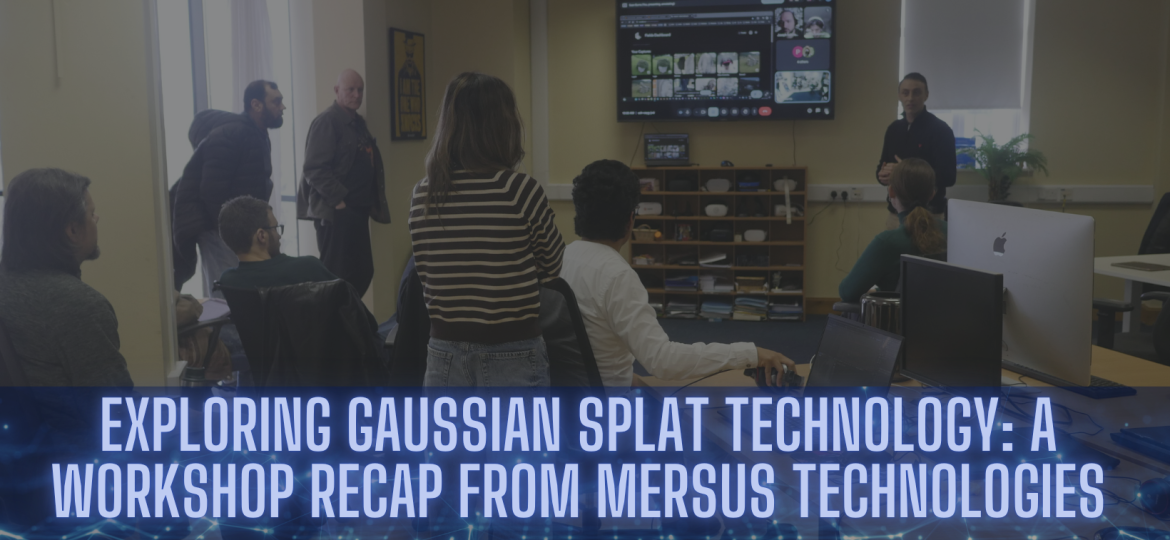
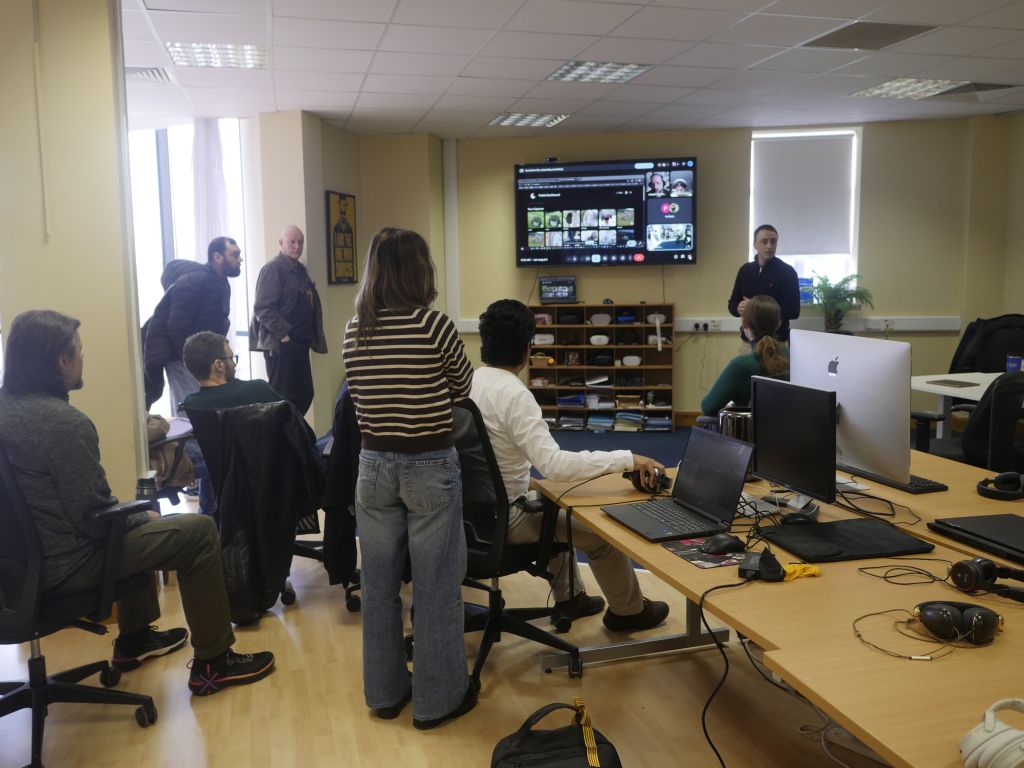
At Mersus Technologies, staying at the forefront of emerging tech isn’t just a goal, it’s part of our DNA. That’s why last week, we hosted an internal workshop on gaussian splats — a breakthrough in 3D image capture. We invited local expert Sean Burns to speak with our team about his use of the tech across various platforms and software programs. The goal was to spark conversation and ideas around how we might employ this technology now or in the future.
What Are Gaussian Splats?
Gaussian splats are a breakthrough in 3D image capture, similar to NeRF (neural radiance fields). Highly detailed 3D images are captured from real-world objects or locations, which can then be viewed from different angles in a remarkably realistic manner. From an easy-to-capture scan, the technology generates a 3D model that includes an approximation of light and shading, making it very lifelike to view. The captures themselves are made up of oblong spots of colour, much like a pointillist or impressionist painting, giving the effect of a realistic replica from a distance
The better your equipment when capturing a scan, the easier it is to get a high-quality capture of the object or environment you’re working with. However, because Gaussian splat technology also estimates and generates the parts of the scanned object, it can’t directly “see,” even a relatively quick scan done on a mobile phone can be used to generate incredibly detailed and realistic captures. This represents a great stride forward, given that just a few years ago, we needed extremely expensive, specialised 3D camera arrays to capture similar results for things like 360° videos. Gaussian splat technology will make the production of 360° video much easier and quicker, leading to more beautiful and immersive results.
Software and Platforms We Explored
Luma
A user-friendly platform for capturing and viewing Gaussian splats, ideal for quickly generating realistic 3D scenes from video or photo sequences. Great for rapid prototyping of environments.
PlayCanvas
A web-based game engine that now supports Gaussian splat rendering. It allows interactive 3D experiences to be embedded directly in a browser, making VR training more accessible without heavy downloads.
Scaniverse
A mobile app (iOS) that captures Gaussian splats using your phone’s camera and LiDAR sensor. Excellent for on-the-go scanning of rooms, objects, or outdoor spaces with surprisingly high fidelity.
Supersplat
A dedicated desktop tool for editing Gaussian splats. You can clean up noisy areas, remove unwanted objects, adjust colours, and even combine multiple splats into one scene. For our workflow, this is key: raw scans often need tidying before they’re usable in VR, and Supersplat makes that process intuitive.
Postshot
Another powerful editing and processing tool, particularly good for refining splats captured from drone footage or video walks. It offers finer control over lighting and background removal, helping us prepare environments for training scenarios.
Kiri Engine
A cross-platform app that creates Gaussian splats from photos. It excels at handling shiny or transparent objects (e.g., glass machinery, wet surfaces), which often confuse older photogrammetry tools.
Marble
A platform for generating splats with a more stylised, game-like look. While most splats aim for photorealism, Marble can produce cleaner, almost cel-shaded results. This is useful for Mersus when we need training environments that are recognisable but simplified for learner focus, or when we want to reduce visual noise in complex industrial scenes.
After exploring these tools, we started asking the obvious question: how does this fit into what we already do?
What This Means for Mersus
For Mersus, this technology has several potential uses. The first and most obvious is getting better scans of real environments we need to recreate for VR. These would still need to be built from scratch by our creative developers, but a Gaussian splat scan would provide a much more detailed and complete reference than the LiDAR scans we currently use for this job, giving developers more accurate data to work with.
Eventually, as the technology improves, these captures could directly generate the actual VR environment. We would still need to model the interactable and close-up parts of the experience, but being able to generate a near-perfect replica of a real environment to place our interactive elements inside would significantly reduce production time. It also holds great potential for our customers, who could use Gaussian splats to recreate their own learning environments as part of the Avatar Academy no‑code VR training builder.
Currently, we are looking for ways to incorporate the technology into our workflow. For example, it could be a great method for introducing detailed background views and skyboxes while keeping visuals optimised so as not to overwhelm the hardware. It’s always a delicate balancing act to combine great visuals with performance, and anything we can do to introduce more immersive imagery without driving up polygon counts is a welcome development.
While Gaussian splats will undoubtedly make scanning real-world environments faster and more efficient, dramatically reducing the time needed to capture accurate spatial data, the high-fidelity worlds we build at Mersus will always require a true 3D instructional designer’s eye. We operate in the learning and training space, where every texture, shadow, and sightline matters, not just for realism but for learning. For learners engaged in high-risk scenarios where real-world mistakes are costly, dangerous, or even life-threatening, authentic immersion isn’t a luxury; it’s a necessity. That’s why we facilitate safe, repeated practice in VR.
However, we also need to work out how to seamlessly incorporate our own 3D models into these captured environments so that learners can actively interact with them. At Mersus, we run active, interactive learning sessions, not passive observation of visually pleasing environments. A beautiful scan is just a backdrop if learners cannot touch, operate, or manipulate the equipment and objects within it. For learning and retention, you need interactivity, not passive observation, and you cannot interact with a Gaussian splat the way real training demands. Our challenge, and our opportunity, is to blend the efficiency of Gaussian splats with the interactivity of our existing 3D assets, ensuring that every training scenario remains hands-on, responsive, and genuinely educational.
But let us be absolutely clear: instructional design and pedagogy are not features we add at the end. They are the heart of everything we do. And it is precisely because of our deep command of technology that we understand this. When you truly know what a tool can and cannot do, you stop being dazzled by the novelty and start asking the harder questions: Does this serve the learning outcome? Does this help the learner retain skills? Does this make practice more effective? Many organisations chase emerging tech for its own sake. We don’t. Our technical expertise gives us the confidence to embrace Gaussian splats where they add value and the wisdom to recognise that no amount of visual fidelity can replace sound pedagogy. Technology serves learning, not the other way around. So while Gaussian splats accelerate our environment capture, it is our mastery of both the tools and the science of learning that ultimately makes the difference. We are learning architects first, but it is our command of technology that allows us to architect with clarity, confidence, and purpose.
Always Innovating, Always Client-Focused
At Mersus, we don’t wait for technology to mature before we start experimenting. We actively seek out tools like Gaussian splats to improve what we build and how we build it. Many of our clients need digital twins of their labs, warehouses, or industrial sites.. Gaussian splat technology has the potential to make capturing and recreating those environments as 3D assets faster and more practical, perfect for a company like Mersus that’s always looking to improve both quality and efficiency
This isn’t a small step forward. It’s a shift that could democratise high-fidelity environment capture, putting the power to create immersive training spaces directly into the hands of our clients.
We’ll continue testing, refining, and integrating the best tools into our workflow. Because for Mersus, emerging tech isn’t just something we follow. It’s something we lead with, always with the goal of making immersive VR training more effective, accessible, and visually stunning for everyone we work with.